


 Neuroscience and Biobehaviroal Reviews
 Revisiting the sigma-1 receptor as a biological target to treat affective and cognitive disorders

The takeaway
The sigma-1 receptor is an attractive target for treating mood and memory disorders. By modulating neurotransmission, neurotrophic factors, and neuroinflammation, sigma-1 ligands consistently demonstrate antidepressant and procognitive effects in animal studies.
The science
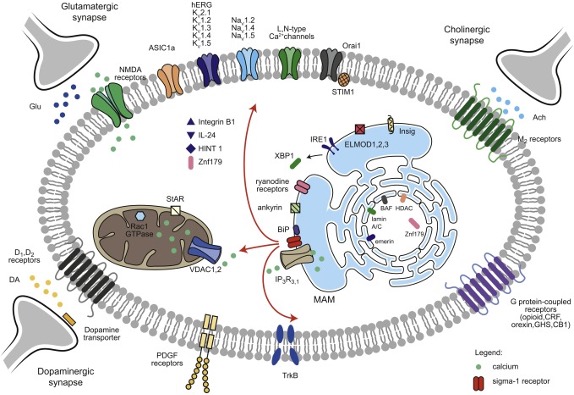
Sigma-1 receptors, located in the endoplasmic reticulum, regulate ion channels, GPCRs, and synaptic plasticity. Knockout mice show depressive-like behaviors with HPA axis hyperactivity and decreased BDNF, while agonists such as SA4503, PRE-084, fluvoxamine, and DHEA reverse immobility and anhedonia via CREB/BDNF and Akt/GSK3β pathways. Sigma-1 ligands also enhance spatial, recognition, and emotional memory, restore long-term potentiation, and protect against deficits caused by β-amyloid or ischemia. Clinical candidates like cutamesine and blarcamesine are currently in trials for depression, Alzheimer’s disease, Parkinson’s dementia, and Rett syndrome.
Why it matters
Unlike typical antidepressants, sigma-1 modulation can target both mood and cognition, providing a dual-action approach. With ligands already in clinical development, sigma-1 receptors emerge as a promising path for innovative psychiatric and neurological treatments.
Orginal article
https://doi.org/10.1016/j.neubiorev.2021.10.037
Our other publications
The initiative focuses on promotion techniques that can revolutionize traditional research approaches pharmaceuticals.

 Life Sciences
 Neuroscience and Biobehaviroal Reviews
  Pharmaceuticals